
Real or Hoax: What CT Scans Actually Show
In 2015, a set of small desiccated bodies surfaced from a cave system in the Peruvian desert near Nazca. Tridactyl hands. Tridactyl feet. Two visibly different body types among them.
And almost immediately, one word attached itself to the story and never let go: hoax.
That's a reasonable starting position. Nazca has a documented history of manufactured specimens sold to tourists, and the internet has no shortage of doctored "alien mummy" photos. Skepticism here isn't closed-mindedness. It's earned.
But skepticism is supposed to update when better evidence shows up. In June 2026, better evidence showed up.
The Study
Dr. K.H. Fung, a radiologist with over forty years of clinical experience, published an independent comparative anatomy study using the original DICOM CT datasets — the same raw scan data hospitals use to image living patients — reconstructed in 3D.
Not photographs. Not a documentary. Cross-sectional X-ray data, sub-millimeter resolution, examined by someone whose entire career has been telling real anatomy apart from anything else.
CT is hard to fool. Sculpted or assembled fakes show up immediately on a scan — glue lines, seams, foreign materials, inconsistent density, tool marks where bone should be. It's the same reason CT is used to authenticate archaeological remains and detect forgeries in museums. Density, alignment, and internal structure don't lie the way a surface can.
Two Body Types, One Cave
Before getting into the findings, here's what was actually recovered: two visibly different body types, from the same cave system.
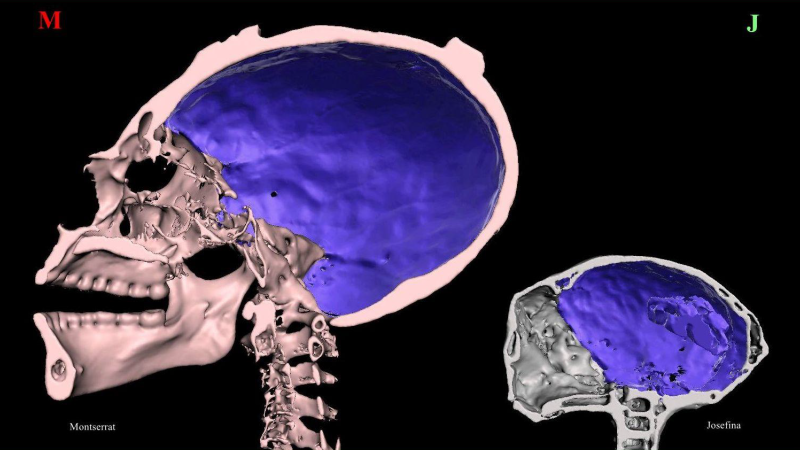
Group One — "M-type." Nicknamed Maria, Montserrat, and Sebastian, including an infant. These read as close to human: a skeleton with paired forearm bones, paired shin bones, a ribcage, shoulder blades, and a pelvis all built on essentially the human blueprint. Full sets of teeth. One of them, Montserrat, was found pregnant — a single, well-formed fetus, positioned in her abdomen.
The one clear departure from human anatomy: hands and feet built around three long, evenly spaced digits instead of five — no thumb, no palm bones, just tridactyl fingers and toes anchored straight into the wrist and ankle.
Group Two — "J-type." Nicknamed Josefina, Luisa, and Alberto. Smaller, roughly two feet long, and internally almost nothing matches human anatomy or the M-type skeleton beside it. A single forearm bone instead of a pair. A single lower leg bone instead of a pair. Hands and feet with three digits again — but this time articulating directly onto a single slab-like wrist or ankle bone, with no palm or sole structure at all. A skull that isn't divided into separate compartments the way a human or M-type skull is — just one continuous hollow structure, with hearing organs in a completely different location than any mammal's. No teeth. A mouth built from hinged bone plates instead of a jaw.
The ribcage doesn't connect to a sternum the way ours does — instead, a shield-like row of belly ribs called gastralia wraps around the front of the abdomen, tracing back to the very first tetrapods to crawl onto land, the amphibian-grade animals at the root of the vertebrate family tree. And where the M-type specimen was pregnant, two of the three J-type specimens were found carrying three large internal eggs each — one of them, Josefina, had two additional smaller ones — with dense, differentiated content the report describes as consistent with embryos.
Same cave. Same tridactyl hand structure connecting them. Otherwise, two very different biological categories.
What Applies to Both
Across both body types, the scans found intact internal organ structures — outlines of trachea, bronchi, heart chambers, blood vessels. Remnant brain tissue inside closed skulls. Bowel content with ingested seeds. Healed skeletal injuries. Bone remodeling around metallic implants. Signs of disease — degenerative bone changes, even tumor-related bone loss in one specimen.
Living systems get injured and heal. Living systems get sick. That's not something you sculpt convincingly. It's something a body does over time, in response to things that actually happened to it.
"...well structured, anatomically coherent, complex, natural" — and could not have been the product of artificial construction.
What This Post Isn't Claiming
This isn't the case for what these bodies are. That's a much bigger conversation, and it's coming.
This is the narrower, more defensible case for what they are not: they are not props. They are not carvings. They are not a hoax that a CT scanner would fail to catch.
Two specimens, sharing one detail — the tridactyl hand — while differing in nearly everything else: skeletal architecture, reproduction, skull structure, digestion. The study's own conclusion is direct: these are "completely different biological entities," despite that one shared trait.
Look at the imaging yourself before you decide what to believe.
