

You Have Ten Fingers. Why Does the World Run on Twelve?
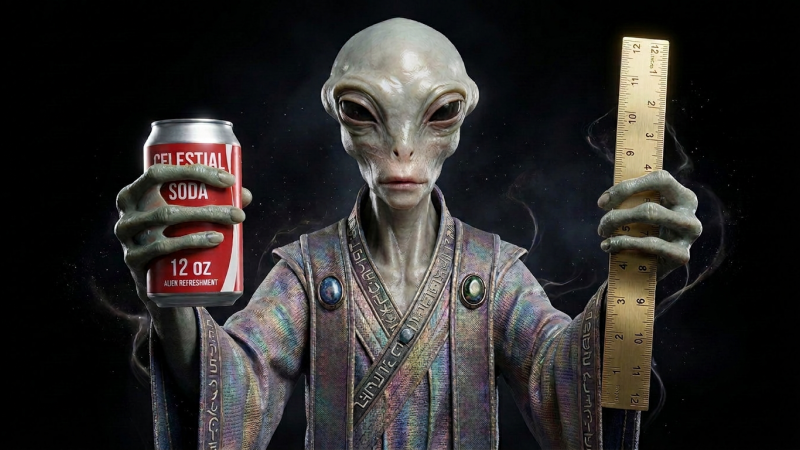
Look at your hand. Five fingers, two hands — ten. Every counting system humans build from scratch reflects that. Base-10.
So why does a foot have 12 inches? Why does a day have 24 hours, a clock run on 60 minutes, a circle divide into 360 degrees? Why do you still buy eggs by the dozen, and why does a soda can hold 12 ounces instead of a clean 10?
None of that is base-10. All of it is base-12, or a direct multiple of it. And nothing about the human body explains where twelve came from.
The Record Has an Answer
The oldest written record on Earth says this mathematics wasn't invented by humans at all. The Babylonian priest Berossus, writing from temple archives in 280 BCE, recorded that civilization began when beings called the Apkallu rose from the sea and taught humanity writing, mathematics, and law — then returned to the water each night. Seven of them are named in Mesopotamian ritual texts, one for each of the earliest legendary kings.
If those beings had three digits per hand instead of five, their full body count — four limbs, three digits each — is exactly twelve. And the most famous number they left behind, base-60, makes sense on two levels at once. In their own counting rhythm, sixty (5 × 12) is just their version of "fifty" — an ordinary round number, the same way one hundred twenty (10 × 12) is their version of "a hundred." It only looks strange to us because we don't count in twelves. That number then got locked into the human record at the actual moment of teaching: two three-fingered hands (3+3=6) meeting two human hands (5+5=10). 6 × 10 = 60. The number was already meaningful on their side. The handshake is why it's the one we still use.
Even stranger: base-60's famous twelve divisors — the reason mathematicians call it "elegant" — is itself the number twelve. The fingerprint isn't just in the systems this math produced. It's inside the arithmetic.
It Shows Up Everywhere
This isn't one culture's story. The Chinese Twelve Earthly Branches developed independently in ancient China. The Chepang language of Nepal has its own native word for twelve — trak — confirmed by linguists as a true duodecimal root, not borrowed. Several Nigerian languages carry independent base-12 counting words. Even Sanskrit and Latin, both decimal languages, layered base-12 structures on top — Rome's calendar, and the Vedic Dwadasamsa dividing each zodiac sign into twelve parts.
There's even a strange biblical detail: 2 Samuel 21:20 describes a giant from Gath with six fingers per hand, six toes per foot — 24 digits total. That's not a different system. That's 2 × 12, the same family.
We Tried to Undo It
In 1795, the French Revolution built the metric system specifically to replace this inherited base-12 framework with something matching human anatomy. They even tried decimal time — ten-hour days. It failed in two years. Everything else got decimalized. The clock didn't.
Whatever built twelve into the way we measure time was too deep to remove — even by a revolution designed to remove it.
This is the short version. The full paper lays out every citation, every culture, every divisor — Berossus in the original, the Apkallu figurines with three digits confirmed in the clay, the complete global table of base-12 systems, and the math itself, worked all the way through.
Read the full paper: The Mathematics We Inherited from NHI: Base-12 — Read the paper. https://tinyurl.com/4jn589as
The answer is in the water.
