
Made in the Image of the Creator: The Origin of the M-Type
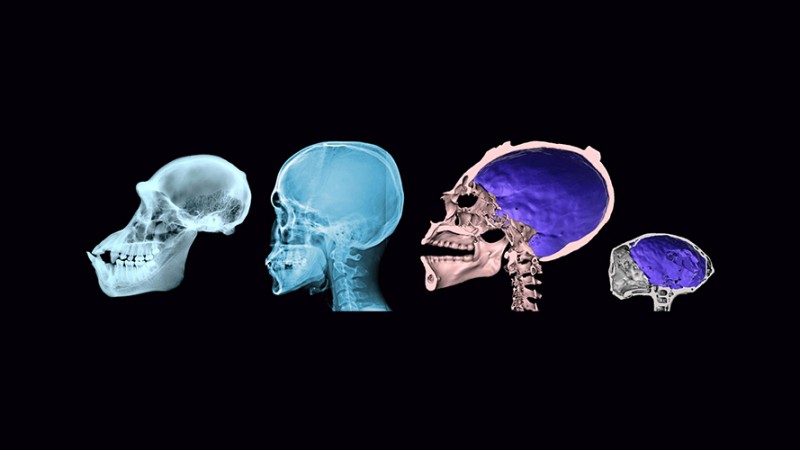
Figure 1. Left to right: chimpanzee, modern human, M-type, J-type — comparative cranial CT.
Look at this image before you read another word.
Four skulls. Same angle. Same scale. A chimpanzee. A modern human. And two tridactyl specimens recovered from underground sites near Nazca, Peru — CT-scanned and published by a retired diagnostic radiologist with forty years of experience reading human anatomy for a living.
The two in the right are not human. They are not chimpanzee. And they are not each other.
By the end of this post, you'll see why one of them appears to have been built to resemble the other — deliberately.
Two Different Beings, Both With Three Fingers
Since 2015, a series of desiccated bipedal specimens have surfaced from cave and tunnel systems in the Peruvian desert. All of them share one unmistakable feature: three fingers, three toes. Beyond that, they split into two completely distinct anatomical groups.
The first group — nicknamed Maria, Montserrat, and Sebastian — looks almost human. Full skeleton, human-style organ layout, a jaw with teeth, a pelvis capable of carrying a pregnancy (one specimen, Montserrat, was found pregnant with a well-formed fetus). Researchers call this group the "M-type."
The second group — Josefina, Luisa, and Alberto — looks nothing like a human being on the inside. Single forearm and leg bones instead of paired ones. A skull that is a single hollow structure with no separation into cranium, sinuses, or jaw. No teeth. An internal beak-like mouth structure. Egg-bearing anatomy. Researchers call this group the "J-type."
CT imaging by Dr. K.H. Fung confirms both groups are real, coherent, once-living biological entities — not hoaxes, not reassembled parts, not artificial constructs. The bone healing, the disease, the scar tissue, the pregnancy — none of that can be faked with a puppet.
So the honest question is: what are we looking at?
The Skull That Shouldn't Exist
Set the J-type aside for a second and look only at the M-type skull next to the human one.
In every naturally evolved hominid lineage — from the earliest australopithecines through early Homo to modern Homo sapiens — there is one rule that never breaks: as brain size goes up, jaw projection goes down. Bigger brain, flatter face. Every single time, in every population, across millions of years. It's not a loose trend. It's a biomechanical package that always travels together, because the same signals that grow the brain also retract the jaw.
The M-type skull breaks that rule. The braincase is larger and more elongated than a human's — but the jaw still projects forward, the same protruding profile you'd expect from an earlier, smaller-brained ancestor. Bigger brain and bigger jaw projection, together, in the same skull. That specific combination does not exist anywhere in the natural fossil record. Not once.
When two traits that are always linked in nature suddenly show up unlinked, that's not evolution taking a shortcut. That's a design choice — someone treating brain size and jaw shape as two separate dials, tuned independently, rather than letting them move together the way nature always does.
Three Fingers Is Not a Human Trait
Here's the detail that matters more than anything else in this post.
Every hominid that has ever lived — every one, going back tens of millions of years to our earliest primate ancestors — has five fingers. Not four. Not six. Five. It is one of the most conserved traits in the entire primate lineage. There is no fossil, no living species, no genetic disorder that produces a naturally tridactyl human hand with fully formed digits, tendons, and joints.
The M-type specimens have three.
So do the J-type specimens.
Two anatomically unrelated beings — one built almost entirely like a human on the inside, the other built like nothing in the animal kingdom — sharing the single rarest possible trait a primate-descended body could have. That is not coincidence. That is a shared design signature.
Built in the Image of Its Maker
Put those two findings together — a cranial vault pulled toward a rounder, more compact shape than any human skull, and a hand that breaks the single most conserved rule in primate anatomy in exactly the direction the J-type's own hand breaks it — and a simple explanation falls out.
Figure 2. J-type (left) and M-type (right) skulls, enlarged for direct comparison.
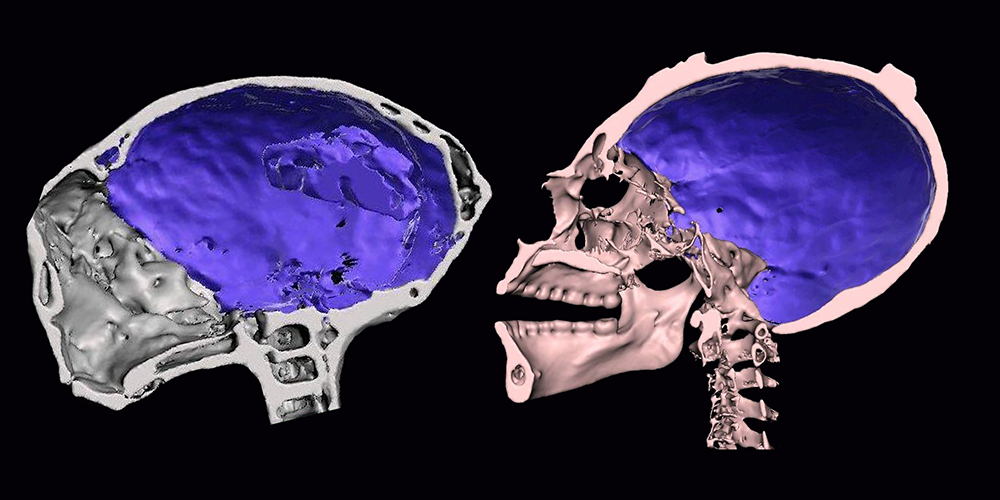
Enlarge the two skulls side by side and the resemblance doesn't disappear into noise — it gets sharper. The same curve runs across the back of both vaults. That's not the kind of thing two unrelated species stumble into by accident.
The M-type wasn't built by copying a human blueprint with a few tweaks. It was built by taking a human-like base and pulling it toward something else entirely — toward the only other tridactyl body plan on record. The engineer didn't design an arbitrary new creature. The engineer built in its own image.
There's a functional reason that matters, not just an aesthetic one. Whatever built the M-type could not have walked among human populations directly — that body plan isn't suited for it. The M-type could. A human-compatible chassis, carrying the maker's own likeness, able to move through human-facing roles the maker's own body never could. Less a copy, more a stand-in — built to carry its maker's authority into places its maker could never go itself.
And it looks like one build couldn't carry the whole resemblance. The maker's face is flat. The maker's skull is rounded and three-dimensional. Those two things appear to fight each other during development — the same way the brain-size-versus-jaw problem above shows two traits that don't want to move together. So the resemblance seems to have been split across two different builds instead of packed into one. Humans carry the flat face. M-type carries the rounded skull shape. Neither one alone is the full picture — together, they're closer to it than either could get on its own.
What the DNA Says
Genomic testing on the M-type reference specimen (deposited publicly on NCBI's Sequence Read Archive, accession SRR20755928) shows a taxonomy breakdown that gets more interesting the closer you look.
86.68% of identified sequences resolve to Catarrhini — the primate group that includes apes and humans. Of that, only 30.22% resolves all the way down to Homo sapiens. A small slice — about 3% — resolves to the Pan genus specifically, not evidence of chimpanzee ancestry, just a genetic marker pointing away from Homo. That leaves 56.46% that reads as primate, unmistakably, but never resolves to our own species — because whatever it actually is doesn't have a matching reference genome in any public database. Science can only recognize what it already has a sample of.
Separately — and distinctly from all of the above — 2.62% of the total dataset doesn't resolve to anything at all. Not primate. Not any classified organism. A genuinely unidentified fraction with no species or lineage attached to it.
A separate, smaller portion of the primate-matching reads resolve specifically to the human Y chromosome and human mitochondrial DNA — the paternal and maternal lineage markers. Independent haplogroup analysis traces that mitochondrial line to a Myanmar-linked population and that Y-chromosome line to a Han Chinese-linked population. In other words: two specific, traceable human ancestral lines, deliberately present in a specimen whose overall skeleton and skull anatomy is not human.
That is not what contamination looks like. Contamination is messy and random. This is targeted and specific — a majority non-resolving primate signature, carrying two precise, identifiable human lineage markers grafted onto it.
Made in the Image
Across nearly every ancient tradition on Earth, the beings who governed early human civilization are described the same way: made in the image of a higher creator, carrying the mark of their maker, holding authority because they visibly resembled the one who made them. That language shows up independently in traditions with no contact with each other — which is usually the strongest signal that a tradition is describing something real rather than repeating a borrowed story.
The CT and genomic evidence now on the table gives that language a physical anchor. A being with a human-adjacent skeleton, a brain-to-jaw ratio no natural evolution produces, a hand shared with only one other known biological entity on the planet, and a genome carrying deliberate, traceable human lineage markers on top of a majority-unresolved primate base — that is not a mutation. That is not a disease. That is not folklore.
It is the physical signature of something built. And it was built to resemble its maker.
The answer is in the water.
Sources
- Fung, K.H. (2026). Peruvian Nazca Tridactyls: Comparative Anatomy between Hominids (M-type) and Reptilian (J-type) Tridactyls. Tridactyls.org. (June 2026) — [link needed; see tridactyls.org/research-papers for the current listing]
- Fung, K.H. (2026). Comparative Anatomy between Human and 'M Type' Tridactyls. Tridactyls.org. (January 2026)
- Culajay, J.F. (2025). The M-Type Enigma: Tridactyl Morphology, Genetic Anomalies, and the Origins of God-Kings. Zenodo. [DOI link needed]
- Culajay, J.F. (2025). Rectamphibius tridactylus: A Provisional Classification of the J-Type Tridactyl Specimens. Zenodo.
- NCBI Sequence Read Archive, Accession SRR20755928. (Public record)
- Hardie, A. Haplogroup analysis of NCBI SRR20755928. Independent research. [link needed if this has been published/hosted anywhere]
Want the full classification framework behind this analysis — the engineering history, the administrative record, and what comes next? That's inside the Inner Circle at anunnakidisclosure.com.
Believe nothing. Observe everything. Follow the fractal.
